
Voices from DIGITAfrica: Prof. Joyce Mwangama on Empowering Women and the Next Generation of Digital Researchers
Today we are delighted to sit down with Joyce Mwangama, Associate Professor in the Department of Electrical & Electronic Engineering at the University of Cape Town, one of the partners of DIGITAfrica. As Head of the Telkom Centre of Excellence in Broadband Networks and Applications and leader of the Intelligent Connectivity Research Group, Prof. Mwangama is actively contributing to the advancement of digital research infrastructures and connectivity across Africa.
In this interview, she shares her academic and professional journey, alongside her perspective on the importance of fostering the participation of women and young researchers in research and innovation. She reflects on the challenges they face, the opportunities to build a more inclusive and diverse scientific ecosystem, and how initiatives such as DIGITAfrica can support capacity building, strengthen collaboration, and inspire the next generation of African researchers.
Read the full interview below.
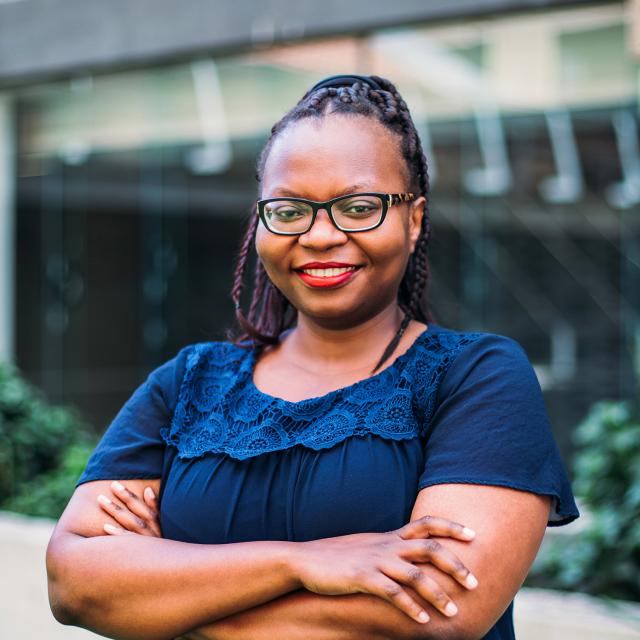
Joyce B. Mwangama
Associate Professor (UCT) | Head: UCT Telkom Centre of Excellence
1. Could you briefly introduce yourself and tell us about your academic and professional journey? What inspired you to pursue a career in telecommunications research and innovation?
I’m an Associate Professor in the Department of Electrical & Electronic Engineering at the University of Cape Town, where I head the Telkom Centre of Excellence in Broadband Networks and Applications and lead the Intelligent Connectivity Research Group. I did my whole academic journey at UCT – BSc(Eng) in 2008, MSc in 2011, and PhD in 2017, all in Electrical and Computer Engineering – and moved from Lecturer in 2015 to Senior Lecturer in 2020 to my current role in 2024. What drew me into telecommunications research was less the technology for its own sake and more what it could unlock: mobile networks are one of the few pieces of infrastructure that have genuinely leapfrogged across Africa, and I wanted to work on the software and network architectures that could turn that reach into real services – in health, connectivity for underserved areas, and beyond.
2. Looking back at your career, what experiences, opportunities, or mentors have had the greatest impact on your professional growth?
My PhD supervisor, Neco Ventura, gave me my start and shaped how I think about research rigour. Beyond that, it’s been the long international collaborations that made the biggest difference – particularly with Thomas Magedanz at TU Berlin/Fraunhofer FOKUS, which has now run for over twelve years, and more recently with Serge Fdida at Sorbonne/LIP6-CNRS. Working inside large European-African testbed projects early in my career exposed me to a scale and rigour of experimental research I wouldn’t have had access to otherwise. A few fellowships were also turning points – the L’Oréal-UNESCO Women in Science Sub-Saharan Africa Fellowship and the Google Anita Borg Memorial Scholarship both came at a stage where that kind of recognition and network access mattered enormously. Serving as IEEE Region 8’s Women in Engineering Chair also pushed me to think beyond my own research and into what structural support other women in the field actually need.
3. Based on your experience, what do you see as the main opportunities and challenges for young researchers, particularly women, who are building careers in research and innovation across Africa?
The biggest opportunity is that African researchers are no longer just adopting mobile technology – we’re increasingly shaping it, through open-source tooling, low-cost testbeds, and growing pan-African and Africa-Europe research partnerships. That’s a real shift from a decade ago. The challenges are less about talent and more about conditions: funding that runs in short project cycles rather than sustained programmes, thin faculty resourcing that spreads early-career researchers across too many roles, and for women specifically, still-limited visibility in senior technical leadership and smaller professional networks to draw on. Building a research career in this environment takes more persistence than it should.
4. Through your involvement in DIGITAfrica, you have contributed to strengthening digital research and innovation ecosystems. In your view, how can initiatives like DIGITAfrica create more opportunities for young researchers and encourage greater participation of women in research and innovation?
DIGITAfrica creates something young researchers rarely get otherwise: direct access to shared European research infrastructure and a structured route into international collaboration, rather than having to build every relationship informally and alone. Through my work on the project – including the Heterogeneous Networking and Edge AI blueprints and the consultation workshops, like the ones we ran in Cape Town and Tunis – I’ve seen how much it changes a young researcher’s trajectory to present alongside established international partners rather than only within their home institution. For women in particular, that visibility matters; opportunities like this put you in rooms and on programmes you might not otherwise be invited into, which is often the harder barrier to clear than the technical work itself.
5. What changes would you like to see in African research and innovation ecosystems to better support young researchers, especially women, in reaching their full potential?
I’d like to see funding models that support sustained infrastructure and people, not just individual project cycles – testbeds and research groups take years to mature, and stop-start funding undermines that. I’d also like more structured, ongoing mentorship rather than occasional exposure at conferences or workshops, and clearer pathways for young researchers to move into leadership on the international collaborations they contribute to, rather than staying in supporting roles indefinitely. And more broadly, our evaluation systems need to properly recognise infrastructure-building and platform work – testbeds, tools, deployed systems – alongside publications, because that’s often where the real long-term impact for the continent sits.
6. What advice would you give to young African women who aspire to pursue a career in research and innovation?
Build technical depth first – it’s the foundation everything else stands on – but don’t wait until you feel fully ready to put yourself forward for international collaborations, leadership roles, or visible platforms. Most opportunities come from being in the room, and you earn the right to be in the room by showing up before you feel entitled to. Find mentors deliberately, and as soon as you can, start being one yourself – it clarifies your own thinking as much as it helps others. And treat the career as a long game: the infrastructure, networks, and reputation you build compound slowly, so consistency matters more than any single breakthrough moment.